Aroumd Village from Imlil: Walk, Views & Local Guide
Walk from Imlil to Aroumd in Morocco's High Atlas. Learn what the route is like, who it suits, what to see, village etiquette and how it connects to Toubkal.
Thousands of hikers pass through Aroumd on their way toward Mount Toubkal. Some remember it only as the first village above Imlil. That misses what makes the walk interesting. You do not need to climb Toubkal to make Aroumd worth the journey.
Aroumd is an Amazigh mountain village above Imlil in the Aït Mizane Valley, at roughly 1,900 metres. It can be visited as a shorter village walk from Imlil and also lies on the approach used for longer routes toward Sidi Chamharouch and Mount Toubkal. From Imlil, I often see visitors think of Aroumd simply as the first village on the way to Toubkal — but the walk itself, the change in elevation and the way the valley opens up are what make it worth slowing down for.
This guide explains what Aroumd is, how it relates to Imlil spatially, what the walk is actually like, and how to decide whether it is the right distance for you. If you are still working out how to reach the trailhead, it pairs with our Marrakech to Imlil transport guide.
Aroumd at a Glance
- Name:
- Aroumd
- Also written:
- Armed / Aremd
- Location:
- Aït Mizane Valley, High Atlas Mountains, near Imlil, Morocco
- Approx. elevation:
- 1,900 m
- Best known for:
- Village walks from Imlil and its position on the traditional approach toward the higher Toubkal valley.
What Is Aroumd Village?
Aroumd is a living Amazigh mountain village in the Aït Mizane Valley, above Imlil in the High Atlas Mountains. It sits at roughly 1,900 metres — about 160 metres above Imlil — and is the first village you reach when walking up the valley from Imlil toward the higher mountain paths.
The Aït Mizane Valley is the main valley corridor that leads from Imlil up toward the Toubkal massif. Aroumd sits within this valley, and the walking route from Imlil passes through or near it before the landscape becomes more clearly mountainous. Many trekkers recognise the name because the standard approach to Mount Toubkal from Imlil follows this same line.
Aroumd is not a tourist construction or a staged cultural stop. It is a village where families live, farm and work. The stone and earthen houses, the terraced fields and the paths between them reflect a practical knowledge of how to live in this mountain landscape — something you can read in the architecture once you know what you are looking at.
Aroumd, Armed or Aremd — Are They the Same Place?
Yes — these names are commonly used online for the same mountain village near Imlil. Online maps, accommodation listings and older travel material may use "Armed" or "Aremd" instead of "Aroumd."
The spelling differences occur when Amazigh and Arabic place names are rendered into Latin characters. This guide uses Aroumd as the standard spelling while acknowledging Armed and Aremd as natural variants. No single spelling is legally or linguistically superior — they are different transliterations of the same village name.
If you are searching for accommodation or directions online, try all three spellings, as listings and maps do not always use the same one.
Where Is Aroumd Compared with Imlil?
Imlil is the principal arrival village — where transport from Marrakech drops you and where most day trips begin. Aroumd sits higher in the same mountain environment, along the route toward the upper Aït Mizane Valley. From Aroumd, higher routes continue toward places covered in their own dedicated guides, including Sidi Chamharouch and the Toubkal refuge and summit route.
The sequence below is a geographic and trekking progression, not a claim that every visitor should walk the full route. Most people who walk to Aroumd do not continue to Toubkal.
Marrakech
City departure point
Imlil
Main arrival village · approx. 1,740 m
Aroumd
First village above Imlil · approx. 1,900 m
Upper Aït Mizane Valley
Valley corridor climbing higher
Sidi Chamharouch
Approx. 2,300–2,350 m
Toubkal Refuge
High mountain base
Mount Toubkal
Summit · 4,167 m
Walking from Imlil to Aroumd
Leaving central Imlil, the path climbs gradually out of the lower village area. The first section follows village lanes and paths that connect Imlil with the hamlets above it. As you gain height, the view back down the valley opens — you can see Imlil below and the road you arrived on, and the scale of the mountains becomes clearer.
The route passes through cultivated areas — terraced fields and, where the season is right, walnut groves. The ground is uneven in places: stone paths, packed earth and village steps. As you approach Aroumd, the clustered mountain architecture of the village becomes visible above you, and the valley character shifts from the lower village environment to something more clearly mountainous.
Walking routes can vary depending on your starting accommodation, the exact path chosen, whether the walk is a direct route or part of a loop, and weather and trail conditions. As a general planning range, the walk from central Imlil to Aroumd is roughly 40–60 minutes one way — but this is approximate and depends on pace, route and conditions. It is never guaranteed.
The return walk follows the same general line back down to Imlil, unless you are continuing higher or arranging a different pickup.
Aroumd Walk at a Glance
| Starting point | Imlil (approx. 1,740 m) |
|---|---|
| Destination | Aroumd village (approx. 1,900 m) |
| Type of walk | Village walk on mountain paths |
| Approximate elevation gain | Around 150–160 m |
| Approximate walking time | Roughly 40–60 minutes one way, depending on route, pace and conditions |
| Terrain | Mountain paths, village lanes, uneven surfaces |
| Difficulty | Easy to moderate for reasonably mobile walkers, depending on route and conditions |
| Best for | A shorter mountain walk with real valley scenery, without committing to a full summit day |
All figures are approximate. Walking time, distance and elevation vary with the exact starting point, route variations and conditions.
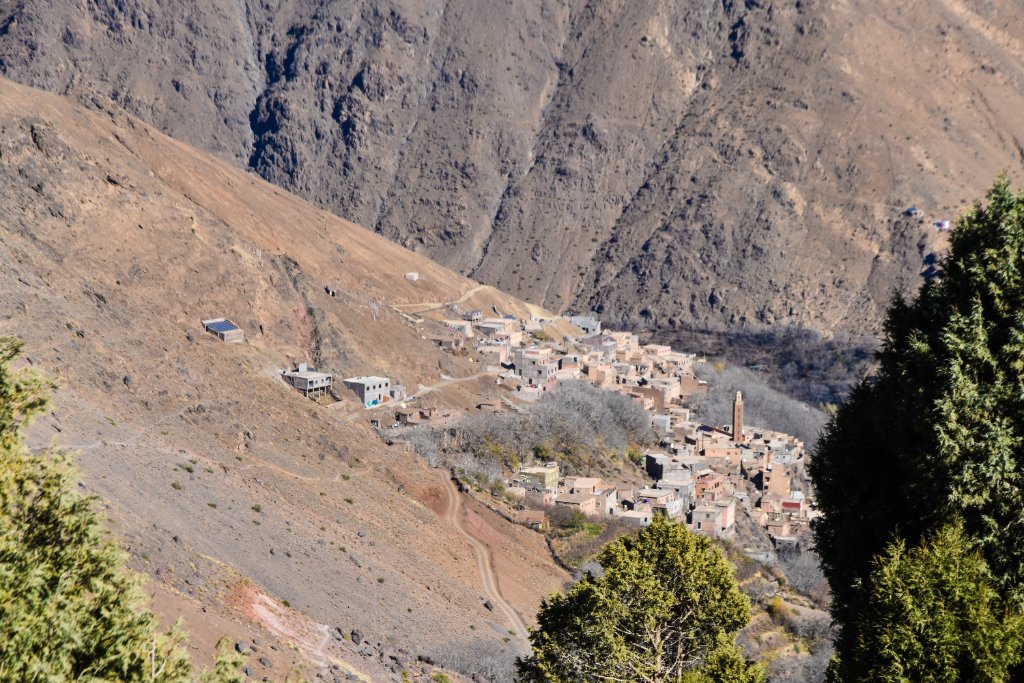
A traditional Amazigh village visible from the valley walking trails above Imlil
Is the Walk to Aroumd Difficult?
The Aroumd village walk is generally much less demanding than the longer, higher-altitude routes. It is not the same kind of effort as the Tasghimout summit hike, the Sidi Chamharouch hike or the Mount Toubkal trek. But it is still mountain walking rather than a flat urban stroll.
There is a steady uphill section leaving Imlil, and the ground is uneven in places — stone paths, village lanes and steps. Good walking footwear with grip is preferable to smooth-soled shoes. In warm weather the sun can be strong on the open sections; in colder periods, temperatures at 1,900 metres are noticeably cooler than in Marrakech.
For a sense of what to expect across the year, see our Imlil weather by month guide rather than relying on a single seasonal average.
What Will You See on the Walk?
The walk is not about one viewpoint or monument. It is about how the landscape changes as you gain height:
- 1
Imlil and the lower valley
The departure point — village buildings, the road in, and the valley floor below the mountains.
- 2
Mountain paths above the village
The path leaves the lower village area and climbs on mountain paths, with the valley opening behind you.
- 3
Terraced cultivation
Working farmland built into the slope — terraces that have been farmed for generations, reflecting a deep knowledge of how to use this land.
- 4
Walnut groves and orchards
Where the season is right, walnut and fruit trees line the path. They are most visible in spring greenery and autumn harvest.
- 5
Aroumd's clustered mountain architecture
The village appears above you — stone and earthen houses built against the hillside, clustered in the way mountain villages are.
- 6
Views into the upper Aït Mizane Valley
From Aroumd, you can see the valley continuing upward toward the higher mountain paths.
- 7
Higher peaks and the Toubkal massif
Where visibility and route allow, the higher peaks are visible above the valley — though this depends entirely on weather and season.
Views depend on weather and season. Snow, mountain visibility, water levels and photography conditions are never guaranteed.
Aroumd Is a Village, Not an Open-Air Museum
Aroumd is a living Amazigh village. People live and work here. The paths you walk on are part of daily village movement — the same routes residents use between homes, fields and the spring. The agricultural land is working land, and the homes are private.
A few practical points of respect make the difference between a welcome visitor and an unwelcome one:
- •Ask permission before photographing people closely.
- •Do not enter homes or courtyards unless invited.
- •Do not walk through cultivated plots simply for a photograph.
- •Keep pathways clear — livestock, mules and residents may need priority on narrow paths.
- •Carry your rubbish out with you.
- •Keep noise reasonable, especially near homes and religious spaces.
- •Respect religious and private spaces — they are not visitor attractions.
The Amazigh people are the indigenous people of North Africa, and Aroumd is an Amazigh village. Approaching the village with that understanding — as a place where people live, not a exhibit built for visitors — is the right starting point.
Understanding the Landscape Around Aroumd
Once you know what to look for, the landscape around Aroumd tells you how mountain settlements work. The village is built against the slope — not on the valley floor — because that position balances access to sunlight, protection from wind and proximity to terraced farmland.
The terraces you see are not decorative. They are working agricultural land, built into the slope to create flat growing surfaces and to manage water runoff. The walnut trees are productive trees — a staple crop in the High Atlas, harvested in autumn. The irrigation channels that run alongside the paths move water from springs and snowmelt to the fields below.
The paths themselves are part of this system. They connect homes to fields, fields to water sources, and the village to the higher valley. When you walk to Aroumd, you are walking on the same network that residents use every day. That is what gives the walk its substance — it is not a trail built for tourists, but a working path through a working landscape.
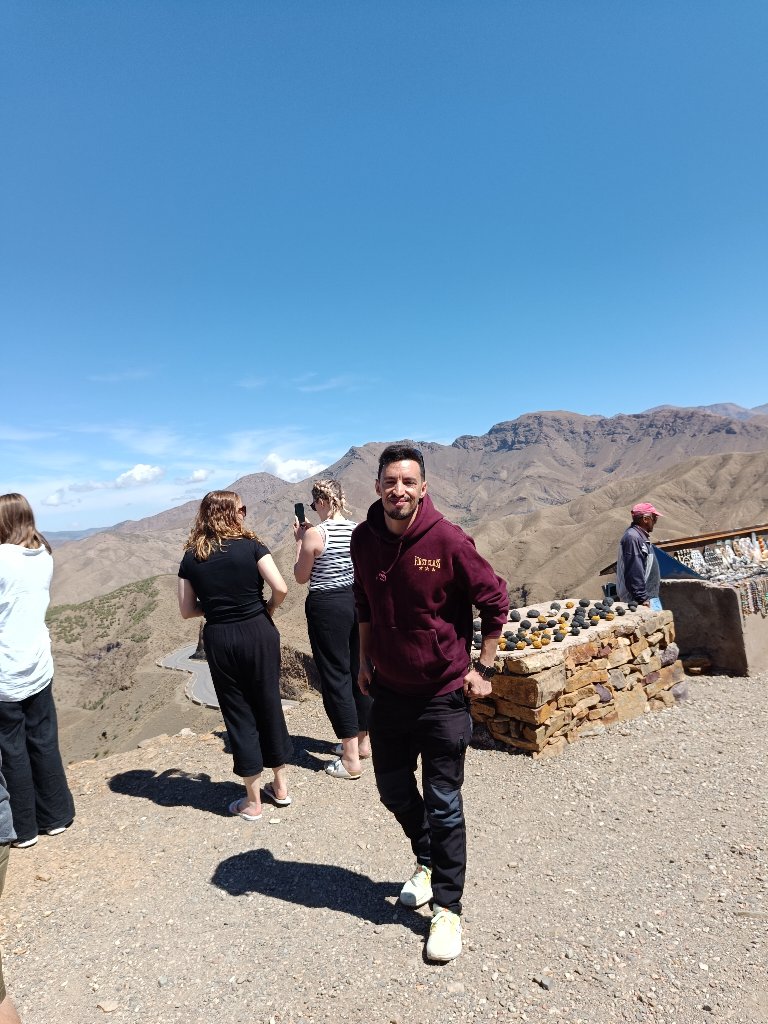
High Atlas mountain scenery above Imlil in the Aït Mizane Valley
Can You Visit Aroumd Without Climbing Mount Toubkal?
Yes — and this is one of the clearest points about Aroumd. You do not need to continue to Sidi Chamharouch, the Toubkal refuge or the summit to make the walk worthwhile. Aroumd works as:
- •A destination for a shorter mountain walk from Imlil.
- •Part of a wider Imlil village walk that introduces you to the Aït Mizane Valley.
- •A turning point — walk up, enjoy the village and the views, and walk back down.
For a broader comparison of walking options from Imlil — including summit hikes, valley hikes and shorter village walks — see our best hikes from Imlil guide. Aroumd is one option among several, and the right choice depends on your time, fitness and what kind of day you want.
Aroumd on the Route to Sidi Chamharouch
Aroumd is the early stage of the longer valley route to Sidi Chamharouch. If you continue past Aroumd, the path follows the Aït Mizane Valley upward toward Sidi Chamharouch at roughly 2,300–2,350 metres — a more substantial day hike that is covered in its own dedicated guide.
For the full route, walking time, elevation, difficulty and cultural guidance for the Sidi Chamharouch hike, see our Sidi Chamharouch hike from Imlil guide. This article does not reproduce those details — Aroumd is the village, and Sidi Chamharouch is a separate, longer objective.
Aroumd on the Route to Mount Toubkal
Many Toubkal trekkers first encounter Aroumd because the standard approach from Imlil continues through this part of the valley. The trail leaves the lower village, passes through or near Aroumd, and then climbs toward the higher mountain paths and the Toubkal refuge. For most trekkers, Aroumd is simply the first village on the way up — a landmark that confirms you are on the right line.
For the full Toubkal route — itinerary, refuge details, summit difficulty, gear lists and costs — see our Mount Toubkal trek from Imlil guide. This article stays focused on Aroumd as a village destination, not as a Toubkal staging point.
Should You Stay Overnight in Aroumd or Imlil?
Choose central Imlil when arrival convenience and services matter more — it is where transport drops you, where most facilities are concentrated, and where short stays are easiest to arrange. Aroumd can suit travellers who deliberately want a mountain-village location closer to the upper valley environment.
Exact accommodation access, luggage handling, meals and vehicle access vary by property. For practical advice on choosing between Imlil centre, Mzik, Aroumd and Tamatert, see our where to stay in Imlil guide — that article owns the accommodation topic in full.
Aroumd for Families and Casual Walkers
Aroumd can work for families and casual walkers who want more than a roadside viewpoint without committing to a major trek. It is a genuine mountain walk with real scenery, and the elevation gain is modest compared with the higher routes.
But route choice matters. Consider:
- •Comfort on uneven mountain paths — the ground is not paved or flat.
- •Uphill walking — there is a steady ascent leaving Imlil.
- •Weather — mountain conditions change quickly; check the forecast.
- •Footwear — proper walking shoes are preferable to smooth-soled shoes.
- •The child's walking ability — every child is different.
- •The exact route — some paths are gentler than others.
It is not a blanket "perfect for kids" walk. For families with younger children or anyone with mobility limitations, a shorter village walk closer to Imlil may be a better fit — and that is a valid choice.
Best Time to Walk to Aroumd
The village can be approached in different seasons, but temperature, rain, snow or ice in colder periods, trail condition and visibility can all change the experience. A walk that is pleasant in spring or autumn can be hot in midsummer or slippery after winter rain.
For a month-by-month breakdown of conditions in the Imlil area, see our Imlil weather by month guide. Never infer current conditions from a monthly average — always check the forecast before setting out.
What to Bring for a Short Aroumd Walk
- •Comfortable walking footwear with grip.
- •Water.
- •Sun protection — hat, sunglasses, sunscreen.
- •A weather-appropriate layer — mountain temperatures change with altitude.
- •A small day bag.
This is a short village walk, not a mountaineering expedition. For serious Toubkal gear — crampons, insulated layers, technical equipment — see our Toubkal packing list.
Is Aroumd Worth Visiting?
Aroumd is worth visiting for travellers who want to experience the landscape above Imlil on foot without committing to a long mountain trek. Its value is not a single monument or attraction. The value is the walk itself: the change in elevation, the valley perspective, the village environment, and understanding how Imlil connects with the higher mountains.
Aroumd does not require a Toubkal trek; for many visitors, the village itself is the right turning point. The interesting part of the Imlil–Aroumd walk is not one attraction but the way the valley changes as you gain height.
Who may not need it: someone with almost no time, or who does not want uphill or uneven walking, may prefer a shorter experience closer to Imlil. That is an honest answer, not a sales pitch — the right walk is the one that fits your day, not the longest one.
Want a local-guided walk to Aroumd?
If you would like to walk from Imlil to Aroumd with a licensed local guide — or include it as part of a flexible Atlas day — message Hamid on WhatsApp.
Licensed local guide · Reply in minutes · No obligation
How Far Into the Valley Do You Want to Go?
Aroumd is one option on a longer progression. Choose the distance that fits your time, fitness and what kind of day you want.
Imlil + Aroumd
Best for village scenery and a shorter mountain walk.
You are here — Aroumd village walk
Mount Toubkal route
Best for prepared trekkers planning a multi-day high mountain objective.
Mount Toubkal trek from Imlil →Hamid Bouredda
Licensed Natural Landscape Tour Guide · Imlil
"The mistake I would avoid is treating Aroumd only as somewhere to pass through. If you are not climbing Toubkal, you can slow the walk down. Look back toward Imlil, notice how the cultivated terraces fit into the slope, and let Aroumd be the destination rather than the beginning of something harder."
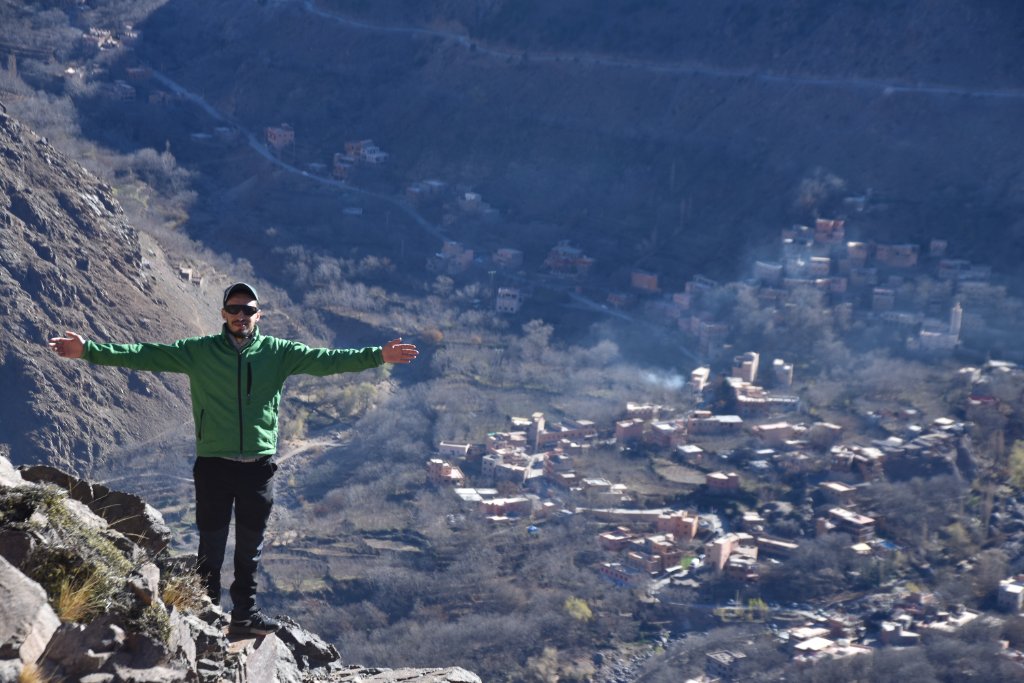
A mountain viewpoint above Imlil looking toward the higher valley
Frequently Asked Questions
Where is Aroumd village?+
Aroumd is an Amazigh mountain village in the Aït Mizane Valley, above Imlil in the High Atlas Mountains of Morocco. It sits at roughly 1,900 metres and is the first village you reach on the walking route from Imlil toward the upper valley.
Is Aroumd the same as Armed or Aremd?+
Yes. Aroumd, Armed and Aremd are different spellings used online for the same village near Imlil. The variation comes from rendering Amazigh and Arabic place names into Latin characters. This guide uses Aroumd as the standard spelling.
How far is Aroumd from Imlil?+
Aroumd sits above Imlil in the same valley, at roughly 1,900 metres compared with Imlil at around 1,740 metres. The exact walking distance varies with the route chosen and the starting point within Imlil.
How long does it take to walk from Imlil to Aroumd?+
As a general planning range, the walk from central Imlil to Aroumd is roughly 40–60 minutes one way, depending on your starting point, the exact path, pace and conditions. Walking time is never guaranteed and varies with route and season.
Is the walk from Imlil to Aroumd difficult?+
It is generally easy to moderate for reasonably mobile walkers — much less demanding than the longer routes to Sidi Chamharouch or Mount Toubkal. It is still mountain walking, with uphill sections and uneven ground, rather than a flat urban stroll.
Can you visit Aroumd without climbing Mount Toubkal?+
Yes. Aroumd works as a destination in its own right for a shorter mountain walk from Imlil. You do not need to continue to Sidi Chamharouch, the Toubkal refuge or the summit. Many visitors walk to Aroumd and return without going higher.
Is Aroumd worth visiting?+
For travellers who want to experience the landscape above Imlil on foot without committing to a long mountain trek, Aroumd is worth visiting. Its value is the walk itself — the change in elevation, the valley perspective and the village environment — rather than a single monument or attraction.
Can you stay overnight in Aroumd?+
Some accommodation exists in and around Aroumd, but exact access, luggage handling and vehicle access vary by property. Central Imlil offers more convenience for arrivals and services. See our guide to where to stay in Imlil for practical accommodation advice.
Do you need a guide to walk to Aroumd?+
The short village walk to Aroumd is navigable without a guide for confident walkers. However, a licensed local guide adds cultural context and access that most independent walkers do not get. For longer routes beyond Aroumd toward Sidi Chamharouch or Toubkal, guide requirements may apply and rules can change — check current guidance before setting out.
Is Aroumd suitable for families?+
Aroumd can work for families who want more than a roadside viewpoint without a major trek, but route choice matters. Consider comfort on uneven mountain paths, uphill walking, weather, footwear and the child's walking ability. It is not a flat, paved stroll and may not suit every child or traveller with mobility limitations.
Related guides:
- → Best Hikes from Imlil: Day Hikes & Mountain Treks
- → Aït Mizane Valley from Imlil
- → Easy Hikes from Imlil
- → Tizi Mzik Hike from Imlil
- → Sidi Chamharouch Hike from Imlil
- → Mount Toubkal Trek from Imlil
- → Marrakech to Imlil: Distance, Transport & How to Get There
- → Things to Do in Imlil, Morocco
- → Imlil Weather by Month
- → Where to Stay in Imlil: Best Areas & Mountain Lodges
- → Small Group Atlas Mountains Day Trip
- → Private Atlas Mountains Day Trip from Marrakech
- → Private Tailor-Made Morocco Experiences
Walk to Aroumd with a Local Guide
If you are staying in Marrakech and want Imlil and Aroumd as part of an Atlas day experience, Hamid can arrange the walk privately or as part of a small-group day trip. Message him directly on WhatsApp.
Licensed local Amazigh guide · Reply in minutes · Direct with Hamid