
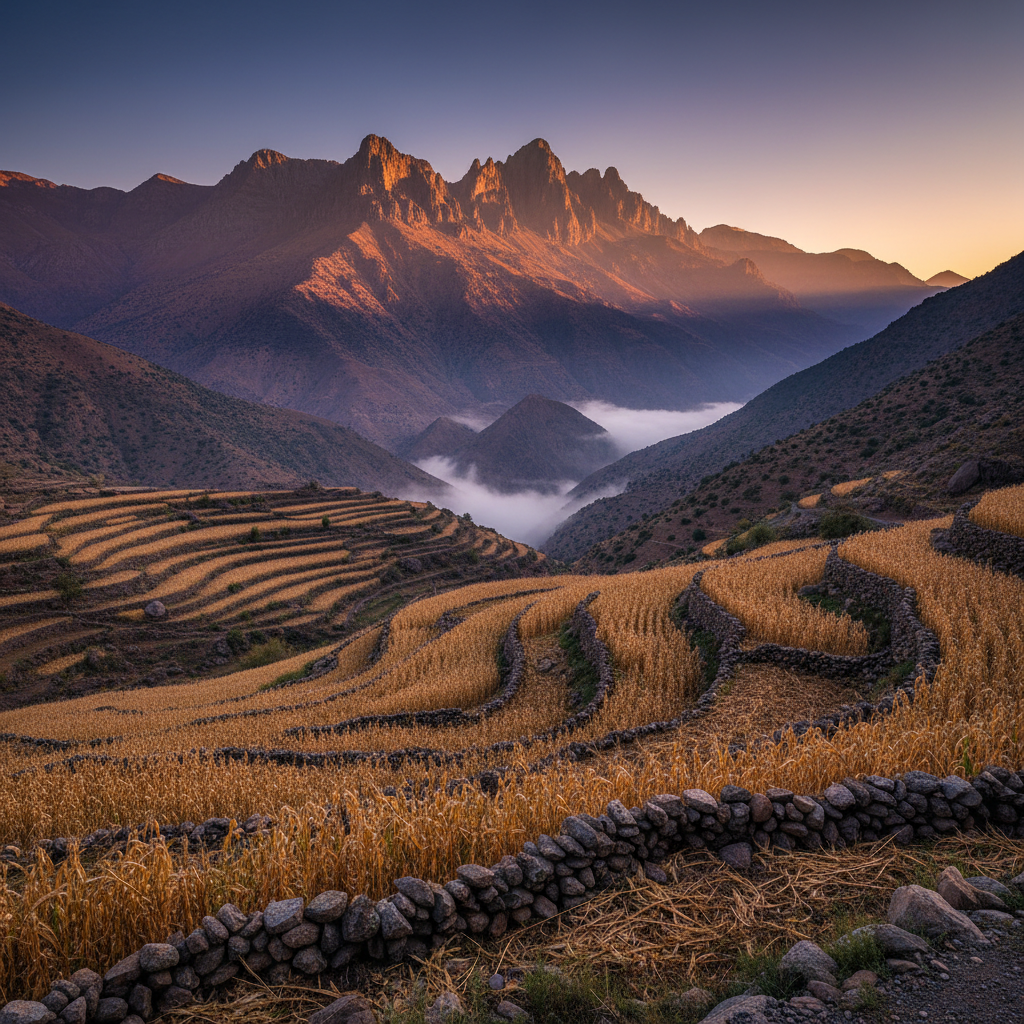
Editorial image inspired by High Atlas village paths at dusk. Not a documentary photograph.
The Night Mule of Mzik: An Amazigh Folklore Story from the High Atlas
In the High Atlas Mountains, stories were not only told for entertainment. They carried warnings, memories, fear, wisdom, and respect for the unseen world. Around Imlil and the nearby villages of Mzik and Ighighan, some stories still live in the memory of the mountains — passed through families, repeated in evenings, and heard differently depending on who is telling them. One of them is the story of Mohamed Bax and the Night Mule.
The Night Mule of Mzik is part of Amazigh folklore in the High Atlas — oral tradition that speaks about fear, harvest, village memory, and the danger of mocking what people do not understand. It is not a ghost story in the modern sense. It is something older and quieter: a story that a community keeps because it feels true, even when its details shift with each telling.
The direct answer is this: The Night Mule of Mzik is an Amazigh folklore story from the High Atlas Mountains near Imlil. It speaks about fear, harvest, night, village memory, and the danger of mocking what people do not understand. As with all oral stories, the details belong to the teller and the community — not to one definitive version.
What follows is one telling of the story, shared in the spirit of cultural respect and with the understanding that it is folklore — not history, not proof, and not something that needs to be believed to be worth hearing.
Discover the High Atlas beyond the views
Walk through real Amazigh villages with Hamid, licensed local guide from Imlil, and experience the stories, culture, hospitality, and mountain life behind the landscape.
Licensed local Amazigh guide · Reply in minutes · No middleman
A Story from the Mountains Near Imlil
The villages of Mzik, Ighighan, and the area near Amour Nkouch sit in the landscape of the High Atlas the way all Amazigh villages do — close to the land, shaped by the seasons, and connected to one another through paths, families, and shared memory. Harvest matters in these mountains. Corn, barley, and vegetables are not abstract crops; they are what a family eats through winter.
Oral folklore is part of how mountain communities remember lessons, warnings, and mysteries. A story passed between generations is not always meant to be taken literally. Sometimes it carries a truth in symbolic form — a way of saying: respect the land, respect the night, respect what you do not fully understand.
Hamid Bouredda is a licensed Natural Landscape Tour Guide from the Imlil area, License No. 1380, Marrakech-Safi Region. He grew up hearing stories like this one — not in books, but in conversation, around tables, from people who knew the mountains and took their stories seriously.
Mohamed Bax and the Destroyed Field
Mohamed Bax was a simple farmer in the High Atlas. Not a remarkable man by any particular account — someone who worked his land, knew his neighbors, and lived by the rhythms of mountain seasons. His cornfield was his livelihood. Which is why, when he found it destroyed, the fear he felt was not only fear of mystery. It was fear of hunger, of a winter without enough, of something beyond his understanding undoing the work of his hands.
The field had been eaten — or trampled, or ruined; the telling varies — in a way that made no ordinary sense. No animal tracks he recognized. No explanation from the village. Just the damage, and the silence of the mountain morning, and the weight of not knowing.
He went to the village elders. Among them was Jaa Nait Hamad, whose name appears across different versions of this story as the one who gave practical advice wrapped in quiet seriousness: watch the field at night. Stay patient. See what comes.
The First Night Watch
So Bax went out into the mountain night. Anyone who has spent time in the High Atlas after dark understands something of what he would have felt. The cold arrives quickly. The valley below disappears into darkness. Distant dogs carry their sound far in the stillness, and then go quiet. The silence is not empty — it has a texture, a depth, and an occasional edge that daylight does not have.
He waited. Nothing happened on the first night, or at least nothing definitive. The story tells it this way because patience is part of the lesson. You do not see everything on the first night. The mountain asks you to return.
He returned the next night, and the next. Each time the cold settled deeper, and the silence stretched longer, and the fear of what might come began to feel more real than the rational arguments against it.
The Appearance of the Black Mule
Then it came. A sound first — heavy, rhythmic, different from the ordinary sound of an animal on a mountain path. Then the shape appeared from the darkness at the edge of the field: a large black mule, moving with a presence that Bax later struggled to describe in ordinary words.
Its eyes. The sound of chains. The way it moved without hurry, without acknowledgment, as though Bax were not there — or as though his being there meant nothing to it. It was not the violence of the scene that broke his composure. It was the particular quality of its wrongness. A mule, and yet not a mule. Something wearing the form of a familiar thing and meaning something else entirely.
Bax fled. The story does not judge him for it. A wise man, the mountains sometimes say, knows when he is not the largest thing in the field.
The Village Laughs at Bax
He returned to the village and told what he had seen. The reaction was almost predictable — not because the people were unkind, but because fear told secondhand always sounds smaller than fear felt firsthand. They laughed. Some with warmth, some with mockery. A mule eating your crops, someone said, belongs to you now. It is your mule. Perhaps you should put it to work.
There is something important in this part of the story. Every version includes the village laughter. Not because laughter is wrong — communities have always used humor to manage the frightening — but because the laughter becomes the hinge on which the rest of the story turns. Those who laugh early in a story like this are being set up for something.
Oral stories often carry a lesson about not laughing too quickly at another person's fear. Not because every fear is justified, but because the act of mockery closes off the possibility of understanding. And sometimes, understanding is what keeps you safe.
The Wedding at Asays
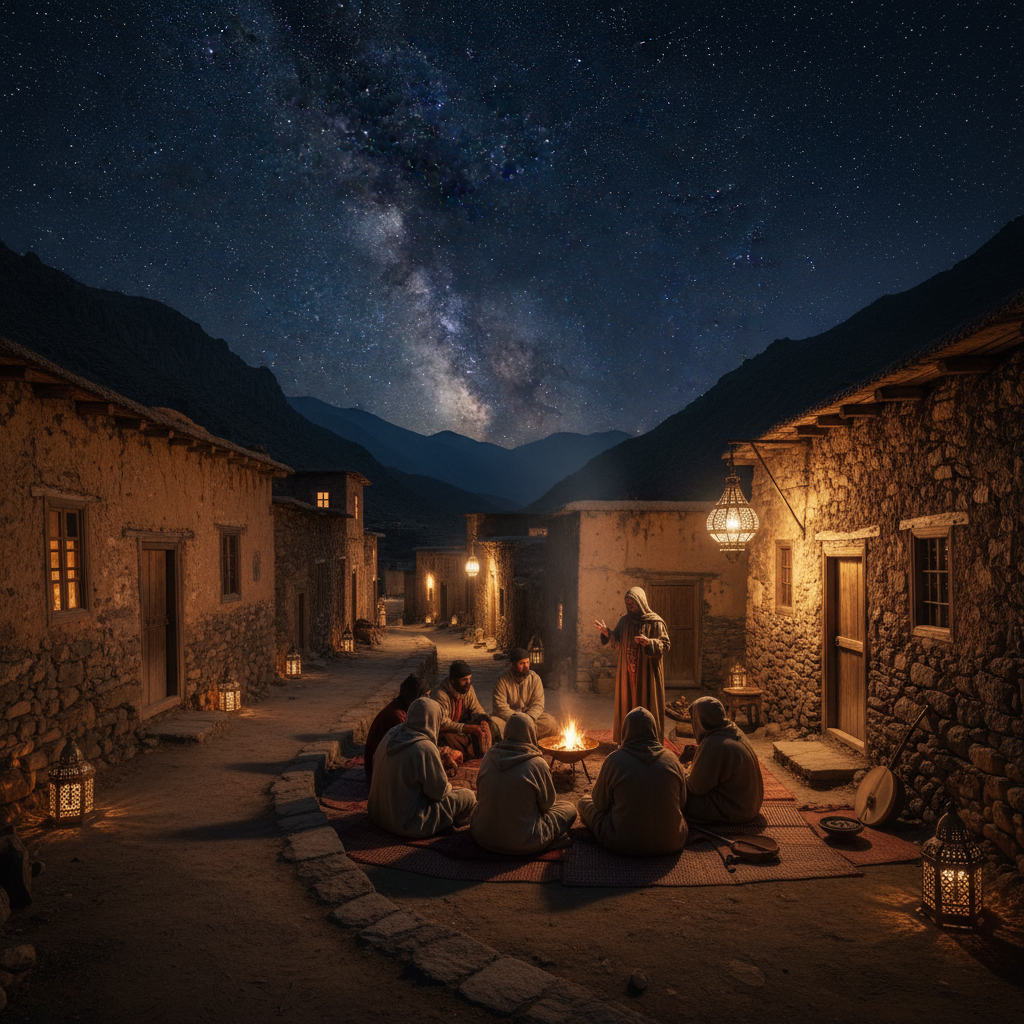
The story moves to a wedding — held at a place called Asays, as these traditional Amazigh celebrations often were. Men gathered. Candles were lit because electricity had not yet arrived in these mountain villages. There was zagharit — the trilling call that Amazigh women make to mark joy — and the warmth of a community coming together in one of the genuinely happy moments that mountain life offers in the spaces between hard seasons.
The atmosphere was exactly what a wedding should be: full of light, sound, food, and the particular ease that comes when a whole village is in the same mood at the same time. And then — at the edge of the gathering, between the candle-lit space and the mountain dark — a sound. Familiar and wrong. The sound from the field.
It appeared smaller this time — a little mule, ordinary-seeming, standing at the edge of the light. Someone laughed. Someone called out something about Bax's mule coming to the celebration. The mockery picked up again, warm with community humor and the relaxed confidence of a group together.
Bax understood what the others did not yet. He had seen it in the field. He knew its size was not fixed.
When the Story Became a Warning
What happened next is told differently in different versions. Some keep it at the level of sound — chains, wind, a sudden pressure in the air, and the candles going out. Some say the mule grew. Some say people ran. Some say the gathering simply ended, and no one spoke clearly about what they had seen, the way people sometimes do not speak clearly about things they would rather not fully believe.
What every version agrees on is the change in tone. The laughter stopped. The warmth left the air with a particular abruptness. The people who had mocked Bax — who had reduced his fear to a joke — understood something that cannot be easily named but can be felt: that they had been wrong to close off their seriousness, and that the mountain had a way of reminding people of that.
From that night, the story of the Night Mule was no longer only Bax's story. It became part of the mountain's memory.
The story does not end with explanation. It ends with understanding. And that, perhaps, is the most honest ending a folklore story can have.
Experience Imlil with someone who belongs to the place
Village stories, mountain paths, and local hospitality. Direct with Hamid — licensed local Amazigh guide from Imlil.
Licensed local Amazigh guide · Reply in minutes · No middleman
What the Night Mule Story May Symbolize
The following is cultural interpretation, not official explanation. Oral stories belong to their communities and resist single meanings.
Fear of the unknown
The Night Mule represents what cannot be explained by ordinary categories. In a farming community dependent on harvest, an unexplained destruction of crops is not just a practical problem — it is a breach in the order of things.
Respect for the land
High Atlas communities have always understood that the land is not simply property. It has its rhythms, its demands, and its way of reminding people that they belong to it as much as it belongs to them.
Night as a space of mystery
In mountain villages without electricity, night had a weight and a reality that modern urban life has largely removed. Stories set at night carry that weight. They use darkness as a character.
Animals in Amazigh storytelling
Animals frequently appear in Amazigh oral tradition as carriers of meaning beyond their ordinary form. The mule — a working animal, familiar and humble — becomes uncanny precisely because of its familiarity.
The danger of mockery
Perhaps the most consistent lesson across all versions: those who mock another person's genuine fear are being invited to understand it from the inside. Humility before the unknown is not weakness — it is wisdom.
Community and individual
The story moves from one man's experience to a collective one. This is how oral traditions often work: the lesson that begins as personal becomes communal. Everyone's story, eventually.
Why Folklore Matters in the High Atlas
Folklore preserves memory in a form that statistics and official records cannot. A story about a destroyed field speaks to the anxiety of harvest in ways that no agricultural report can match. A story about community laughter turning to silence speaks to the fragility of certainty in a way that no historical account can fully capture.
Stories connect people to land, seasons, harvest, family, animals, village life, and the unseen dimensions of experience that every community carries. They are how mountain communities have always taught caution, humility, and respect — not through sermons but through narrative.
Travelers who visit Imlil with a local guide can understand more than landscapes. They can understand the culture behind the place — the stories, the values, the particular way that people in the High Atlas have always made sense of their world. This is what makes a real local experience fundamentally different from a quick mountain viewpoint stop.
Experience Imlil Beyond the Views
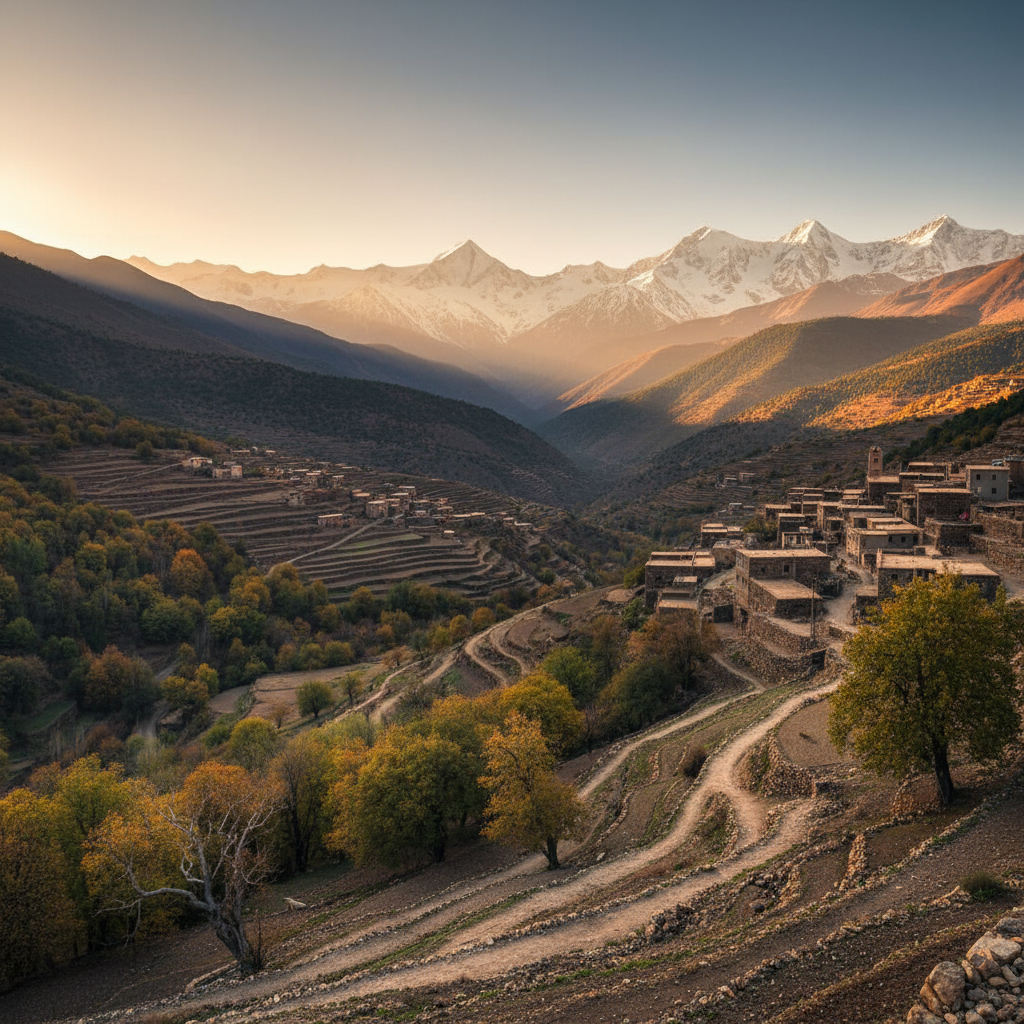
Imlil is not only mountain scenery. It is a place of stories, families, paths, traditions, hospitality, and local memory. The cornfields, the stone terraces, the old paths between houses, the village wells, the particular way tea is poured — all of it is part of a living culture that has its own language, its own calendar, and its own stories about why the world works the way it does.
A private Atlas Mountains day trip from Marrakech with Morocco Elite Guide means walking through this landscape with someone who grew up in it. Hamid can point to a field and explain what it means to a family through winter. He can tell you why a particular path was built where it was, why a terrace faces a certain direction, and what the old houses were designed to hold besides people.
You can also experience the warmth of Amazigh hospitality directly — including a local family lunch in Imlil that brings together food, mountain views, mint tea, and a real sense of what village life looks and feels like when you are invited into it rather than observing it from a distance.
This kind of experience is especially meaningful for culturally curious travelers, families, couples, and premium travelers who want meaning behind the mountains, not only photographs of them.
Private Cultural Experiences in the High Atlas
For travelers who want a deeper experience, a private day trip allows more time for conversation, village walking, stories, lunch, and quiet viewpoints. There is no schedule pressure, no large group to keep together, and no need to filter the experience through a crowd.
The day can be adapted to the traveler's pace, interests, and comfort level. Some guests want to walk further. Some want to sit on a terrace with tea and talk. Some want to understand the landscape. Some want to hear stories. Hamid can accommodate all of this because he knows the place and because the communication with guests happens directly — before the trip, on WhatsApp, in real conversation.
For those interested in a fully bespoke High Atlas experience, Morocco Elite Guide also offers private tailor-made experiences in Morocco — multi-day treks, cultural immersion programs, or whatever shape the trip needs to take. The starting point is always a conversation with Hamid.
Final Answer: Why Remember the Night Mule of Mzik?
The Night Mule of Mzik is more than a mysterious story. It is part of the living cultural fabric of the High Atlas Mountains — oral tradition that speaks about harvest, community, fear, humility, and the particular knowledge that comes from living close to land that is always larger than any single person's understanding of it.
For travelers, hearing a story like this is a reminder that Imlil is not only a mountain destination near Marrakech. It is a living cultural landscape, shaped by families, harvests, paths, hospitality, and stories passed from one generation to another.
For travelers interested in Amazigh folklore in the High Atlas, stories like the Night Mule of Mzik open a deeper window into local culture around Imlil — one that cannot be seen from a viewpoint, photographed from a tour bus, or read from a guidebook written by someone who was never there.
It can only be heard from someone who belongs to the place. And that is exactly what Morocco Elite Guide offers.
Read more about the cultural depth of the Amazigh family experience in our article on Amazigh folklore in the High Atlas and local family hospitality in Imlil.
Frequently Asked Questions
Walk Through Real Villages. Hear Real Stories. Feel the High Atlas.
Book directly with Hamid, your licensed local Amazigh guide from Imlil. Village stories, mountain paths, mint tea, local family lunch, and a genuine connection to the High Atlas.
Licensed local Amazigh guide · Reply in minutes · Direct with Hamid · No middleman
Related guides & experiences:
- → Private Atlas Mountains Day Trip from Marrakech
- → Amazigh Prestigia House — Local Family Hospitality in Imlil
- → Inside an Amazigh Family House in Imlil
- → Best Atlas Mountains Day Trip from Marrakech
- → Quiet Escape from Marrakech to Imlil
- → Private Tailor-Made Morocco Experiences
- → Contact Hamid
- → All Atlas Mountains Travel Guides